
- 首页 >> Research >> Research Progress
Research Progress
Shanghai Institute of Technical Physics discovers the “Exciton-Polariton Photodetection Effect”State Key Laboratory of Infrared Physics
On January 17, Professors Weida Hu and Jinshui Miao of the State Key Laboratory of Infrared Physics, Shanghai Institute of Technical Physics (SITP), Chinese Academy of Sciences (CAS), have proposed a “exciton-polariton photodetection effect” for the first time. By introducing self-hybridized exciton-polaritons as the dominant transport quasiparticles under non-equilibrium conditions, this work reshapes the generation and transport mechanisms of photocarriers in photodiodes. The study breaks through the physical bottleneck of thermal-equilibrium exciton diffusion in conventional devices and provides a new approach for developing high-efficiency, high-speed photodetection. The result was published in Nature Communications titled “Exciton-polariton photodiodes.”
Excitonic semiconductors possess strong light-absorption capabilities and have broad application prospects in the fields of photodetection and energy conversion. However, the performance of conventional excitonic optoelectronic devices is limited by a fundamental issue: photogenerated excitons can only achieve charge separation by reaching the interface through random diffusion. Due to the limited exciton diffusion length and significant scattering processes, it is difficult for devices to simultaneously balance quantum efficiency, response speed, and absorption bandwidth. This transport limitation has become a key challenge constraining the development of excitonic photodiodes.
To address this challenge, the research team introduced non-equilibrium strong light-matter coupling directly into the photoelectric transport process and constructed a self-hybridized exciton-polariton optoelectronic device without an external optical cavity. In this system, exciton-polaritons no longer serve merely as optical excited states but directly participate in and dominate the photoelectric transport. Benefiting from the coexistence of strong excitonic absorption and the light effective mass of photons, the device achieves a synergistic enhancement of absorption, transport, and response speed. Experimental results demonstrate that a stable strong coupling state can be achieved at room temperature. The device’s absorption bandwidth is extended, and the quantum efficiency evolves along the polariton dispersion, approaching unity under zero-detuning conditions. Meanwhile, long-range transport dominated by non-equilibrium exciton polaritons effectively suppresses scattering and recombination, resulting in a response speed superior to that of conventional excitonic photodiodes.
This study systematically reveals for the first time the new photoelectric effect produced by exciton-polaritons as transport quasiparticles, demonstrating that strong light-matter coupling can reshape the dynamics of photoelectric conversion and transport under non-equilibrium conditions. This achievement marks a shift in excitonic optoelectronic research from optimization strategies centered on materials and interfaces toward a new physical paradigm centered on quasiparticle manipulation. It lays the physical foundation for the development of non-equilibrium optoelectronics and novel polariton photodetectors.
This research was supervised by Prof. Weida Hu and Prof. Jinshui Miao of the State Key Laboratory of Infrared Physics, who served as corresponding authors. PhD student Qixiao Zhao is the first author. This work was supported by the Strategic Priority Research Program of the Chinese Academy of Sciences, National Natural Science Foundation of China, National Key Research and Development Program of China, and CAS Project for Young Scientists in Basic Research.
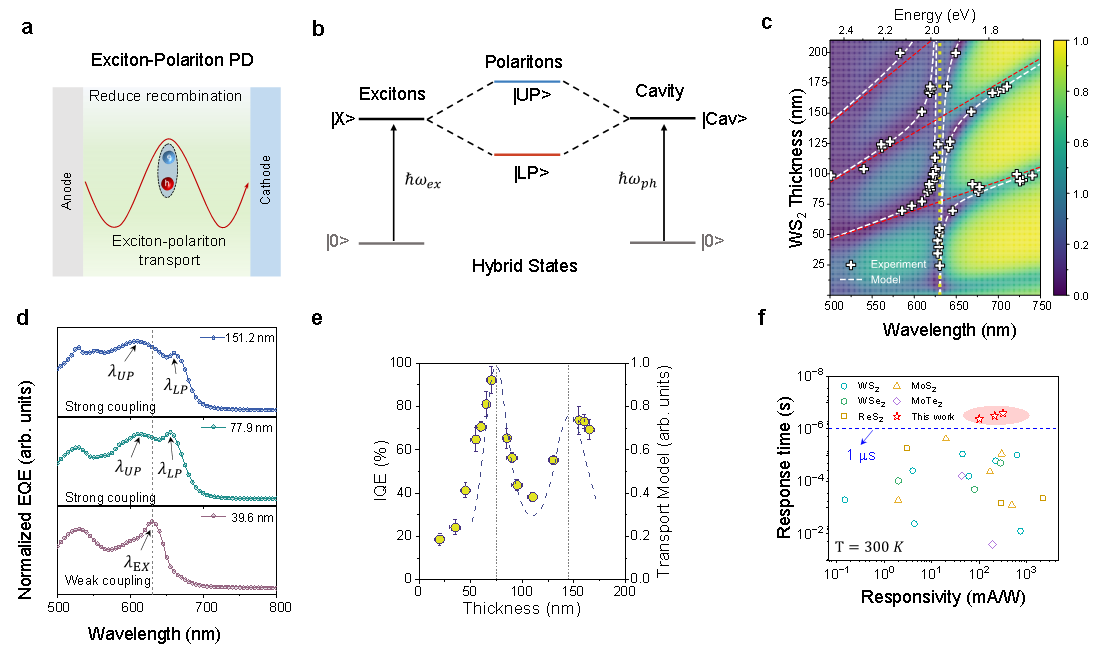
Exciton-Polariton Photodetection Effect and Its Quasiparticle Transport Characteristics
Link to the papers: https://www.nature.com/articles/s41467-026-68312-8