
- 首页 >> Research >> Research Progress
Research Progress
Shanghai Institute of Technical Physics Achieves Significant Breakthrough in Berry Curvature Dipole-Driven Nonlinear Quantum Terahertz Conversion
Researchers at the State Key Laboratory of Infrared Physics, Shanghai Institute of Technical Physics (SITP),including Lin Wang, Xiaoshuang Chen and Weida Hu, have achieved an important advance in Berry-curvature-dipole-driven nonlinear quantum terahertz conversion. By engineering the geometric phase of electron wavefunctions (Berry curvature) in a type-II Weyl semimetal, the team developed an “all-in-one nonlinear Hall rectenna” that operates without a P–N junction, overcoming fundamental limitations in conventional terahertz detection imposed by thermoelectric voltage thresholds and carrier transit times. The work, entitled “An all-in-one Hall rectenna with a bandwidth over 100 GHz,” was published in Nature Electronics.
In optoelectronic detection and signal processing, conventional diode architectures have long played a central role. Traditional diodes rely on P–N junction barriers to create charge transport asymmetry, enabling rectification. However, this band-engineering-based mechanism is fundamentally constrained by thermoelectric voltage thresholds and carrier transit times. These limitations become particularly severe in the infrared and terahertz (THz) regimes, where achieving high sensitivity, broadband response and room-temperature operation simultaneously remain challenging. Recent advances in quantum materials research have revealed that the geometric phase information embedded in electron wavefunctions—Berry curvature—acts as an intrinsic “virtual magnetic field” in momentum space. This provides a fundamentally new degree of freedom for controlling carrier dynamics directly in k-space, marking a transition from conventional band engineering toward wavefunction-geometry-based optoelectronic control.
Leveraging the broken spatial inversion symmetry and topological properties of the type-II Weyl semimetal NbIrTe4, the team constructed a novel terahertz detector. Unlike conventional diodes, the device requires neither external bias nor magnetic field. Instead, the intrinsic quantum-geometric asymmetry of the material generates a transverse nonreciprocal current under THz electric-field excitation via the nonlinear Hall effect. Experimental results demonstrate outstanding room-temperature performance. The nonlinear Hall rectenna achieves broadband rectification spanning from radio frequency to terahertz frequencies (20–820 GHz), exhibits a broadband frequency comb exceeding the 27th order, enables subharmonic mixing at low input power (−25 dBm), and delivers a detection bandwidth over 100 GHz. These results indicate that by optimizing quantum-geometric coupling, electronic nonreciprocal transport can be realized without reliance on interface barriers.
This work innovatively integrates quantum geometry with antenna rectification concepts, representing a paradigm shift from barrier-driven to geometry-driven rectification mechanisms. The study not only bridges topological physics and optoelectronics but also demonstrates that Berry curvature can dominate high-performance optoelectronic responses at room temperature. It provides a quantum-material-based solution to long-standing challenges in terahertz detection and signal processing, with potential applications in future room-temperature, low-power, highly integrated THz sensing, communication and imaging systems.
In a related News & Views article titled “A nonlinear Hall rectenna in NbIrTe4,” published in Nature Electronics, Professor Su-Yang Xu of Harvard University commented that the device overcomes the fundamental constraints of conventional P–N junction diodes associated with thermoelectric voltage thresholds and carrier mobility. He highlighted the nonlinear Hall rectenna as establishing a “junction-free, broadband microwave-to-terahertz detector and mixer,” offering a promising alternative platform for next-generation communication, sensing and wireless energy harvesting technologies.
SITP is the sole corresponding institution of the study. Dr. Zhen Hu, a postdoctoral researcher, is the first author. The research was supported by the Strategic Priority Research Program of the Chinese Academy of Sciences, the National Natural Science Foundation of China, and the Shanghai Natural Science Foundation.
Link to the papers:https://www.nature.com/articles/s41928-026-01574-8
Contact: Dr. Zhen Hu. Email: huzhen@mail.sitp.ac.cn
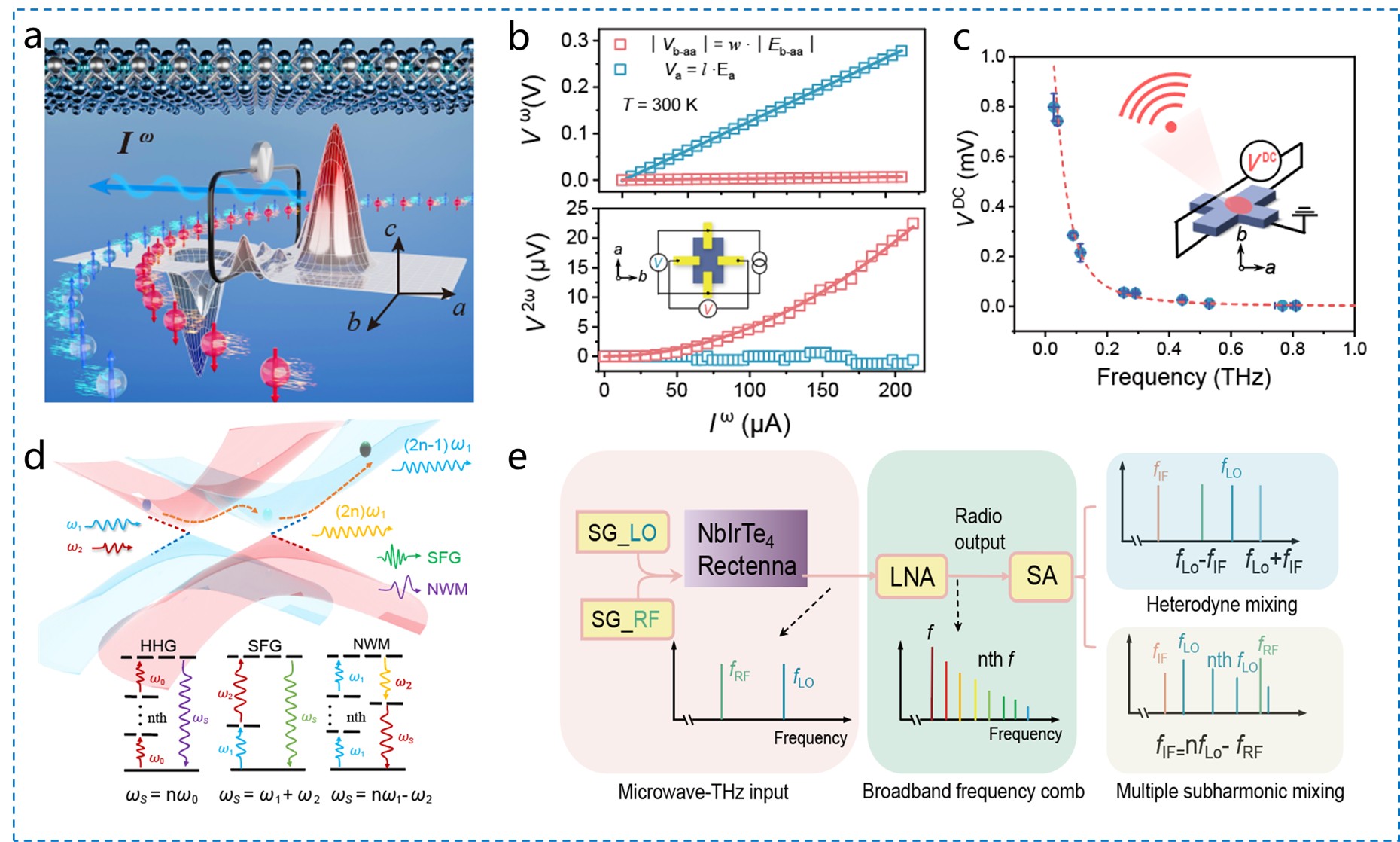
Figure 1. (a) Schematic of the physical mechanism of the nonlinear Hall effect driven by Berry curvature: The non-reciprocal transport process of electrons under the action of a quantum geometric potential field is shown. (b) nonlinear Hall effect at room temperature. (c) Broadband detection from 20 to 820GHz. (d) The nonlinear frequency conversion mechanism generated under the Wael point: a variety of nonlinear processes of sum frequency, difference frequency and N-wave mixing. (e) Multifunctional integration enabled by the mechanism.