
- 首页 >> Research >> Research Progress
Research Progress
SITP and Collaborators Report Major Progress in Direct Imaging and Non-Equilibrium Enhancement of Hot-Electron Thomson Cooling
As semiconductor process technology approaches its physical limits and power densities at the micro- and nanoscale continue to rise, heat dissipation has become a central bottleneck for electronic devices in the post-Moore era. Classical Thomson cooling is constrained by lattice-dominated heat dissipation and the weak variation in carrier entropy under thermal equilibrium; within the Boltzmann–Onsager framework, its efficiency has long remained difficult to raise beyond 2%. Moreover, because direct means of probing hot-electron dynamics have been lacking, thermoelectric responses exceeding the classical thermal-equilibrium limit had not previously been revealed experimentally.
Recently, a team led by Professor Pingping Chen at the State Key Laboratory of Infrared Physics, Shanghai Institute of Technical Physics, Chinese Academy of Sciences, working with teams led by Professor Zhenghua An at Fudan University and Professor Wu Li at Eastern Institute of Technology, Ningbo, has made progress in the direct imaging of hot-electron Thomson cooling and the mechanism underlying its non-equilibrium enhancement. For the first time, the researchers simultaneously imaged the electron temperature, lattice temperature, and corresponding thermoelectric responses in HgTe and HgCdTe nanochannel devices, directly observing a non-equilibrium Thomson cooling effect that exceeds classical theoretical predictions.
The related findings were published in Nature Physics under the title “Imaging hot-electron Thomson cooling beyond the Boltzmann–Onsager framework.”
Building on their long-term research on HgTe-based materials, the team grew high-quality HgTe/HgCdTe quantum wells on large lattice-mismatched GaAs substrates through interface and composition control. Using a custom-developed combination of scanning noise microscopy (SNoiM) and scanning thermal microscopy (SThM), they obtained, for the first time, simultaneous maps of electron temperature, lattice temperature, and thermoelectric signals in a device under steady-state operation.
The extremely weak electron–phonon coupling in HgTe allows hot electrons to be transported while remaining nearly “decoupled” from the lattice. In the HgTe/CdTe nanoconstriction device, the electron temperature reached approximately 1,720 K, sustaining a non-equilibrium Thomson compensation temperature difference of approximately 200 K. In the HgCdTe control device, the electron temperature was only approximately 760 K—a reduction of about 67%—and the thermoelectric signal was almost completely quenched.
In a 1 μm-wide HgTe channel, the Thomson cooling compensation ratio reached approximately 9% in the lattice channel and approximately 14.3% in the electron channel, substantially exceeding the classical near-equilibrium limit of approximately 2%. When the channel was widened to more than 3.5 μm, the response returned to the classical value, confirming that the enhancement arises from high-field-driven non-equilibrium hot electrons rather than an intrinsic material anomaly.
First-principles calculations and a two-temperature model show that, at high temperatures, broadening of the Fermi edge strengthens the dependence of the Seebeck coefficient on electron temperature, and that the Thomson-coefficient term dominates the observed nonlinear thermoelectric response.
These results provide the first direct imaging evidence that the low efficiency of the Thomson effect is not a universal physical limitation, but rather a consequence of the assumptions of classical equilibrium theory. Non-equilibrium hot electrons constitute a key channel for energy dissipation and control at the nanoscale, offering a new physical approach to on-chip heat dissipation for post-Moore-era devices and a useful reference for thermal management in HgTe-based infrared detectors.
|
PUBLISHED IN NATURE PHYSICS Imaging hot-electron Thomson cooling beyond the Boltzmann–Onsager framework |
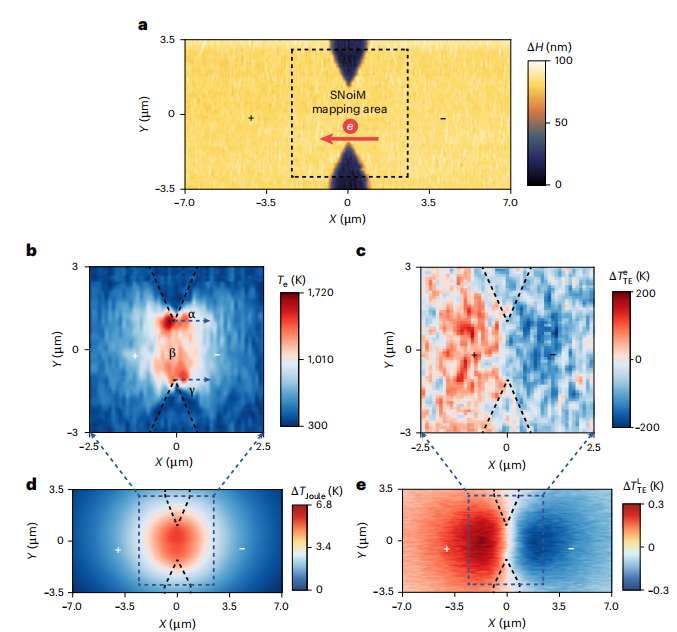
Figure. Imaging of Joule heating (b, d) and thermoelectric responses (c, e) for electrons (b, c) and the lattice (d, e) in an HgTe nanoconstriction.
Professor Zhenghua An of Fudan University, Professor Pingping Chen of SITP, Chinese Academy of Sciences, and Professor Wu Li of Eastern Institute of Technology, Ningbo, are co-corresponding authors of the paper. This research was supported by the National Key Research and Development Program of China, the National Natural Science Foundation of China, the Quantum Science and Technology Innovation Program, and the Explorer Program of the Shanghai Science and Technology Commission, among others. Sample fabrication was completed on the Intelligent Scientist Platform of the Chinese Academy of Sciences.